


As the Paper and Packaging Waste Regulation (PPWR) raises the bar for packaging recyclability, choosing the right material matters more than ever. Billerud’s European portfolio of fiber-based paper and packaging materials is tested for recyclability using recognised industry methods. This means we can help you comply with today's regulations while gaining a valuable competitive edge.
Future-proof your packaging - with tested recyclability
The standards in the new PPWR are high, but Billerud has been meeting high standards for many years. PPWR introduces stricter requirements for packaging design, recyclability, and waste reduction to support a circular economy.
Contact us and we will help you find a solution that aligns with your sustainability goals, customized with tomorrow in mind.
Implementation timeline
2026 | General application of PPWR provisions and all packaging must be recyclable |
2028 | The EU defines criteria for what qualifies as recyclable packaging |
2030 | All packaging must comply with the design-for-recycling requirements and achieve a weighted recyclability score of at least 70% |
2035 | Packaging must be effectively recycled at scale |
2038 | The recyclability score requirement increases to 80% |
Timelines and percentages may be subject to change.
WHAT DOES THE EXPERT SAY?
We asked five quick questions to Johan Ericson, Public Affairs Director at Billerud, about the evolving regulatory landscape. As new requirements reshape the packaging industry, companies need to prepare now to ensure compliance and remain competitive. Click to learn what’s evolving and how to stayahead of the changes.
Fresh fibers - critical for recycling
Packaging made from fresh fibers is crucial for keeping recycling going. High-quality paper can typically be recycled up to six times before its fibres lose strength. In Europe, during 2023, every fiber completed on average 4.8 cycles of recycling, meaning there is potential for increasing recycling rates.
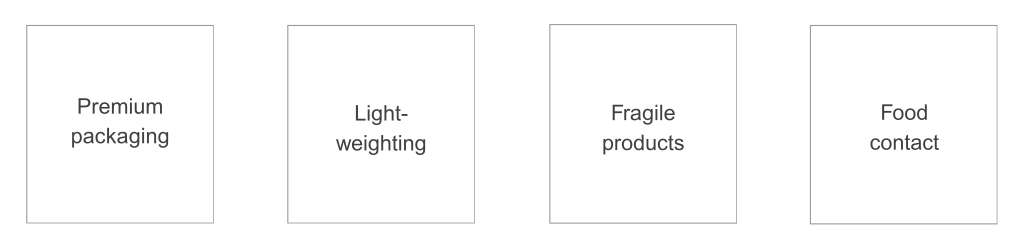
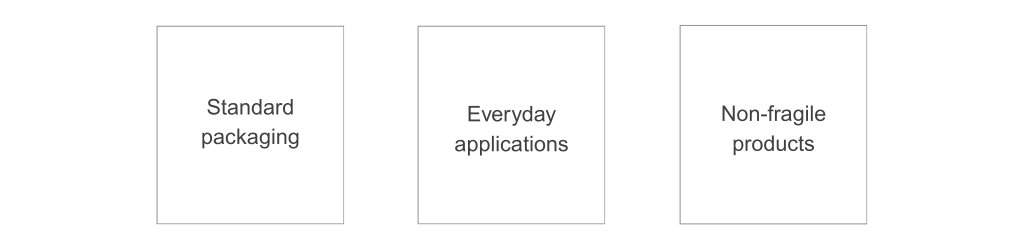
When to choose what type of fiber
Choose the material that best matches your needs is an art. Fresh fibers provide strength, purity, and protection while recycled fibers are usually a smart choice for less demanding applications. Moreover, fresh fibers are a prerequisite for recycled fibers.
FRESH FIBERS
RECYCLED FIBERS

How we assess recyclability
Billerud has a long history of assessing recyclability according to recognised industry methods. Products developed for our European portfolio up to 2022 are covered by PTS certificates. For products launched after 2022, recyclability is tested through laboratory testing according to the CEPI method, the current European laboratory test method for assessing the recyclability of paper and board-based materials.
The CEPI method
For newer products in our European portfolio, we use the CEPI Recyclability Laboratory Test Method to assess technical recyclability. The results help demonstrate how materials perform in today’s paper recycling systems and provide documented support for PPWR compliance.
Packaging and Packaging Waste Regulation (PPWR)
All packaging used in the European market must be reusable, recyclable or compostable. The PPWR is part of the comprehensive European Green Deal, which aims to make the EU the world’s first climate-neutral continent by 2050.
A broad perspective on sustainability
Billerud not only works hard with recyclability. We also take pride in our wider role as a pioneer of sustainability. We constantly try to reduce our environmental impact. One of many improvements is the diminishing use of fossil fuels in our worldwide operations.
Billerud’s European production is already 98% fossil free*. Our goal now is to make production completely fossil free. The removal of fossil fuels severely reduces the environmental impact of paper production and aligns with the global push towards using renewable energy sources. One of the key elements for a fossil-free production is a stable and efficient production. This demands putting safety first.
All paper production uses a lot of energy. Most of this energy is generated in the pulp process, where a lot of waste heat is released. We mainly use this excess heat in our production, but it also provides local communities with heating. This use of waste heat in our own production has reduced our carbon footprint and saved energy. In our European operations, we generate up to 40% of our electricity internally. All electricity, produced in-house or purchased, is covered by fossil-free energy certificates. We work continuously to increase the overall energy efficiency of our facilities and to find new ways to further increase the amount of energy produced from sustainable, fossil-free sources.
*Applies to our European portfolio
Using the railway, recovering chemicals
In 2022, 70% of the outgoing land transports from our European mills travelled by rail. Together with carriers, we are pushing for the transition to a fossil-free fleet. We will continue to actively choose the mode of transport and monitor developments in technology and fuel, railway expansion and the electrification of roads.
The chemicals used to release the fibers from the wood are recovered and reused in a cyclical process. Wood residues after fiber extension are used for energy.
The PTS method
The recyclability analysis is carried out in accordance with the PTS method PTS-RH 021:2012 (Draft Oct 2019). This method is also called, ”Identification of the recyclability of paper and board packages and of graphic print products”.
Some facts about the criteria:
Disintegratability
This refers to the mass percentage of the constituents not usable in papermaking. This is based on the removed-dry non-paper constituents and reject of nondefibrated fiber constituents after 0.7-mm hole-plate fractionation. This criterion and the related yield in recyclable fiber is evaluated on the following basis:
This may include both non-disintegrated fiber agglomerates, coating and adhesive particles, as well as any non-paper constituents such as flat particles from coatings and laminations. Disintegratability is rated by means of the mass percentage of the reject and additionally described in qualitative terms.
This percentage is either based on the manufacturer’s statements or is estimated. For estimates, the following percentages and assessments are taken into account:
- Non-paper constituents eliminated by manual dry removal during specimen preparation, such as closures, grips, windows etc.
- Polymer and other non-paper coatings, laminations and liners that can be evaluated based on the reject content after Brecht-Holl fractionation and can be detected during a visual inspection of the accept sheets after Haindl screening. Ink particles and adhesive applications are not included.
This percentage is the total of the percentage of the reject from Brecht-Holl fractionation and of the percentage of removed-dry non-paper constituents.
This value results from the mass of initial material less the mass of total reject. It is based on the oven-dry total mass of the initial material.
Purity of the furnish mass percentage usable in papermaking. An assessment of potential impacts on circuit waters or effluents is not part of this method. This criterion is evaluated on the following basis:
Undisturbed sheet formation test
This is assessed on the basis of the following two tests:
- Sheet adhesion test on handsheets made of the obtained stock (both total stock and accept from screening) to detect adhesive impurities (stickies) caused by e.g. Glued side wall and bottom panels, Coating binders, Polymer and other non-paper coatings, laminations and liners, Adhesive labels and tapes and Adhesive contaminants (stickies) in paper and board made of recycled fiber.
- Visual inspection for optical inhomogeneities such as:
• Dirt specks due to ink, coating, metal, paint, glue etc.
• Transparent or white spots or flaws due to stickies, plastic particles, coating particles, etc.
• Through-coloured conspicuous fibers and significant stain of the handsheet due to colorants.